
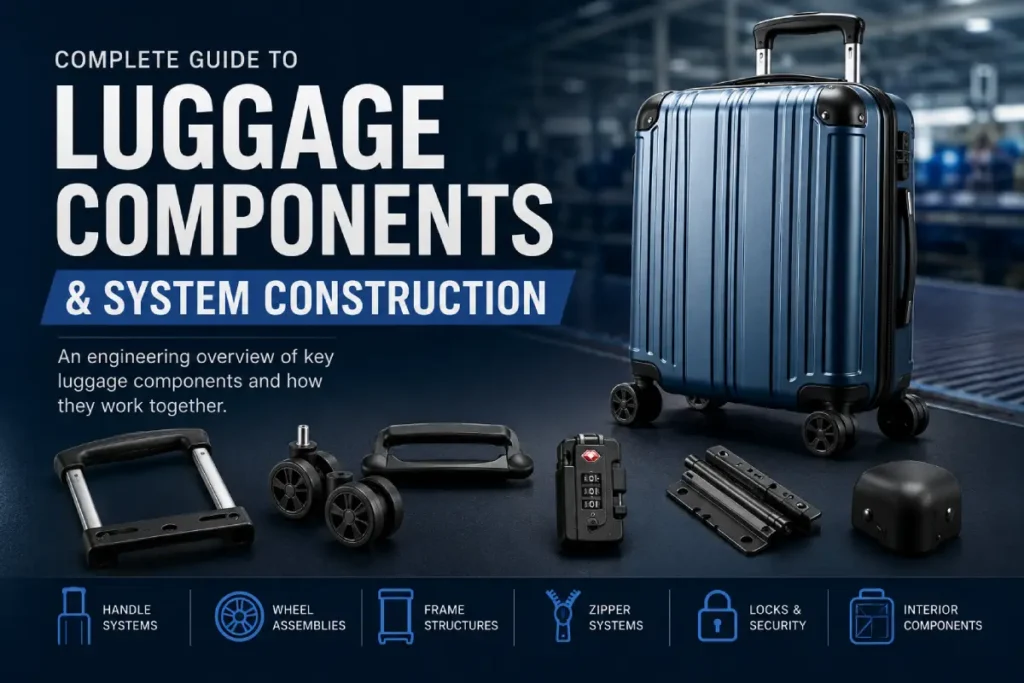
Luggage components and their system consistency, along with structural reinforcement methods and assembly precision across large production batches, are what truly determine luggage performance in actual manufacturing environments—far more than just shell appearance or material thickness.
Most luggage factories source or manufacture telescopic handles, wheel assemblies, locks, support frames, and interior systems separately before final assembly begins. Small dimensional inconsistencies between these parts can create handle instability, wheel misalignment, zipper stress, or shell deformation after repeated transportation cycles.
For luggage brands and importers developing OEM projects, evaluating luggage components individually often provides a more accurate indication of product durability than shell material specifications alone.
This guide explains the main luggage components used in modern suitcase manufacturing, how these systems are produced, and what factories typically evaluate during OEM luggage development and mass production.
Telescopic Handle Systems
The luggage handle system remains one of the highest failure-rate areas in luggage production because the structure absorbs continuous pulling force, directional movement, vibration, and impact during travel handling.
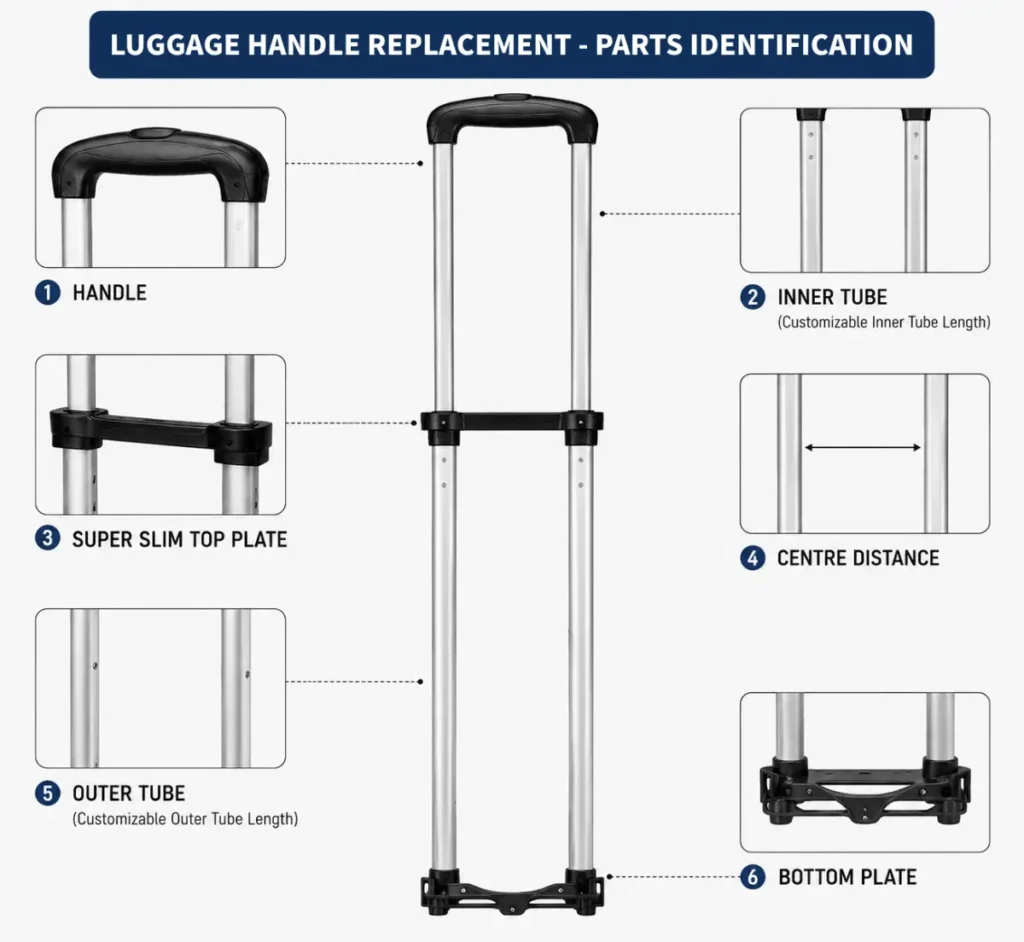
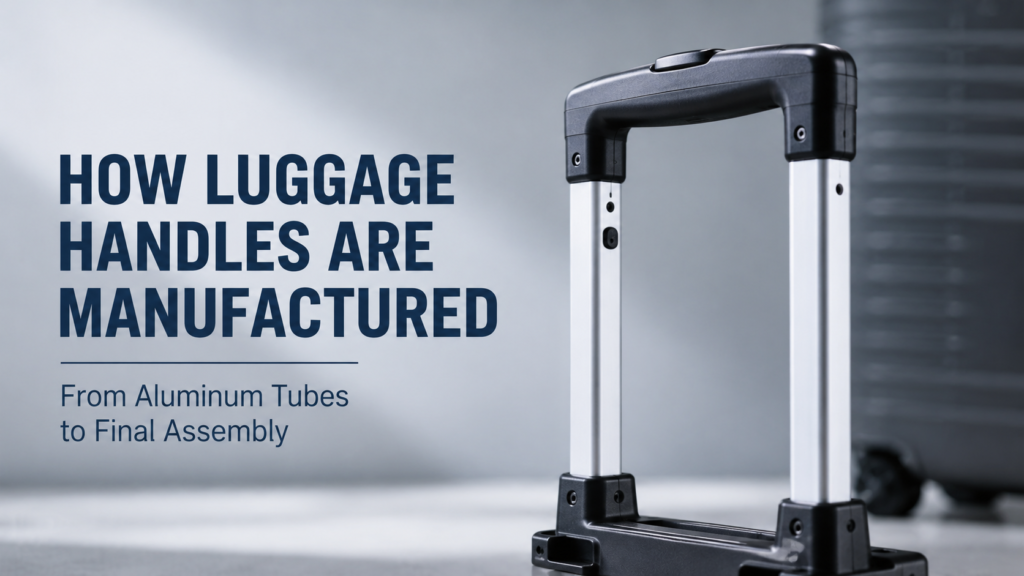
A standard luggage handle assembly generally includes aluminum tubes, injection-molded grips, locking buttons, internal guide rails, mounting brackets, and reinforcement plates integrated into the shell structure.
Tube wall thickness and locking accuracy directly affect handle rigidity. Factories producing lower-cost luggage often reduce material thickness inside the aluminum tube system to lower production cost, although this usually increases handle movement after repeated extension cycles.
In OEM luggage manufacturing, handle alignment becomes especially important during assembly. Even small tolerance variation between shell drilling positions and mounting brackets can create instability once the suitcase is fully loaded.
Many luggage brands source telescopic systems separately from specialized luggage component suppliers when projects require custom dimensions, replacement compatibility, or reinforced structures for heavier luggage collections.
Handle systems intended for export markets usually undergo repeated cycle testing before mass-production approval. Factories commonly simulate thousands of extension and retraction movements to evaluate locking consistency and structural fatigue.
Luggage Wheel Assemblies
Wheel systems directly influence rolling stability, movement noise, directional control, and long-term wear resistance.
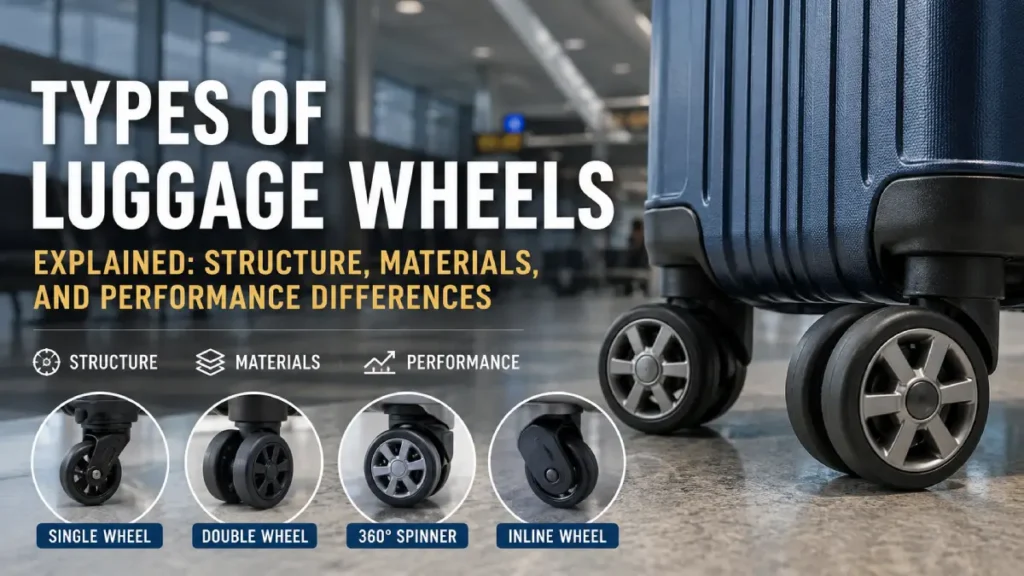
Most modern luggage uses spinner wheels with either single- or double-wheel configurations. Double-wheel systems distribute load more evenly during movement and are widely used in medium and large check-in luggage.
A typical wheel assembly contains:
- wheel housing
- bearing structure
- axle system
- mounting plate
- reinforcement bracket
Wheel material selection varies depending on luggage positioning and target market. Polyurethane-coated wheels are commonly used in mid-range and premium luggage because they generate lower rolling noise and maintain smoother movement on uneven flooring surfaces commonly found in airports and urban transportation areas.
Factories manufacturing large luggage volumes generally run wheel fatigue testing under continuous rolling conditions before shipment approval. Testing procedures often simulate extended travel distance under full loading conditions to evaluate axle deformation, bearing wear, and wheel cracking.
Wheel mounting stability also depends heavily on shell reinforcement design. Weak support structures around wheel areas frequently become the starting point for cracking in hard-shell luggage after repeated baggage handling impact.
Frame Structures and Load Support Systems
The frame structure controls shell stability and affects how impact force transfers across the suitcase during transportation.
In zipper luggage, frame reinforcement normally remains hidden inside the shell perimeter. Aluminum frame luggage follows a different structural approach where the frame itself becomes part of the external load-bearing system.
Factories typically use combinations of:
- aluminum support frames
- riveted corner structures
- internal reinforcement bars
- molded support plates
Poor frame rigidity often leads to shell distortion near wheel positions or telescopic handle mounting zones after repeated compression loading.
Manufacturers producing OEM luggage for international brands usually reinforce high-stress areas differently depending on luggage size. Cabin luggage and large check-in luggage rarely use identical reinforcement structures because load distribution changes significantly once suitcase dimensions increase.
In large-scale luggage production, frame alignment consistency becomes important for maintaining zipper positioning, shell closure precision, and wheel balance across production batches.
Zipper Systems and Closure Construction
Zipper failure remains one of the more common problems in luggage products used under heavy loading conditions.
Most luggage factories use either coil zipper systems or reverse zipper structures, depending on water resistance requirements and product positioning.
The zipper assembly normally includes:
- zipper tracks
- slider systems
- reinforcement stitching
- pull tabs
- support tape structures
Premium luggage collections often use thicker zipper teeth combined with reinforced sewing around curved shell sections, where stress concentration becomes higher during overpacking.
For aluminum frame luggage, zipper systems are replaced by mechanical locking structures integrated directly into the frame assembly.
Factories manufacturing export luggage generally test zipper movement consistency after full assembly because shell deformation during production can affect zipper alignment.
TSA Locks and Security Hardware
Most luggage products developed for international retail markets now integrate TSA-compatible locking systems.
Lock assemblies commonly include recessed housings, combination mechanisms, zipper locking channels, and impact-resistant outer covers designed to reduce external damage during baggage handling.
During production, lock installation accuracy matters because dimensional deviation between the lock housing and shell cutout areas can affect locking reliability after repeated use.
OEM luggage projects intended for North American and European markets often require different lock certifications depending on distributor requirements and retail compliance standards.
Corner Reinforcement and Shell Protection
Corner areas absorb a large percentage of impact force during airport handling, conveyor transfer, and container loading.
Factories generally reinforce these areas using external corner guards, internal reinforcement plates, riveted support sections, and double-layer shell structures.
ABS luggage usually requires more reinforcement around wheel corners and side impact zones because thinner ABS structures deform more easily under repeated compression loading compared with thicker PC shells. [ABS vs PC vs Aluminum Luggage: Material Selection in Modern Suitcase Manufacturing]
Manufacturers producing lightweight luggage collections constantly balance shell thickness, reinforcement weight, and transportation durability during product development.
Reducing total product weight too aggressively often increases structural failure rates during long-distance transportation.
Interior Components and Sewing Systems
Interior assembly affects storage organization, appearance stability, and long-term usability.
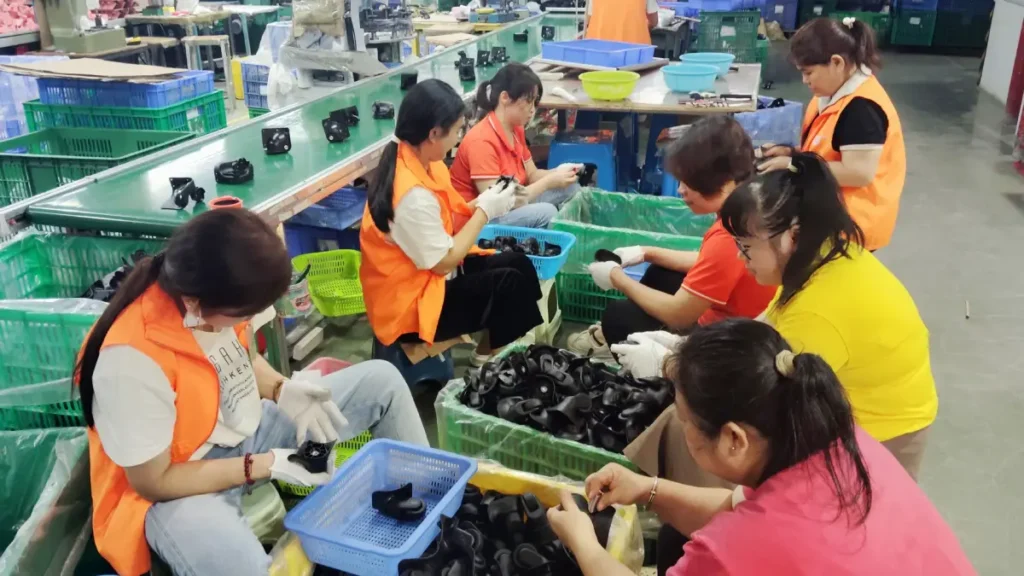
Most luggage factories sew interior components separately before installation into the shell structure. Typical interior systems include divider panels, compression straps, zipper pockets, support boards, and lining fabrics.
Mid-range and premium luggage products often reinforce stitching around stress points where fabric tension increases during overpacking conditions.
Interior fitting accuracy also affects the final product’s appearance. Loose lining structures frequently create deformation or wrinkling after repeated use, especially in larger luggage sizes.
Soft-shell luggage manufacturing relies even more heavily on sewing consistency because the external structure itself depends on fabric reinforcement and panel construction quality.
Luggage Components Compatibility in OEM Manufacturing
Component compatibility becomes increasingly complex when luggage factories source handle systems, wheel assemblies, locks, and shell tooling from different suppliers.
A telescopic handle structure developed for one shell platform may not align correctly with another wheelbase or internal reinforcement system without dimensional adjustment.
Before mass production begins, factories usually conduct repeated fitment verification across multiple luggage sizes to ensure consistent assembly positioning.
This stage is closely connected to the broader luggage factory process because component tolerances, shell forming accuracy, and assembly consistency all influence final fitment performance. Manufacturers developing large OEM projects often evaluate these issues during early production planning stages outlined in our guide on how luggage is manufactured.
This stage becomes especially important for replacement part programs, multi-size luggage collections, and aftermarket repair compatibility, and distributor inventory standardization
Manufacturers supplying international luggage brands often maintain separate tooling records and dimensional inspection systems to reduce variation between production batches.
In large OEM luggage projects, component consistency across thousands of units usually matters more than isolated sample quality.
Modern luggage manufacturing depends on the coordination of multiple mechanical and structural systems rather than shell material alone.
Handle stability, wheel durability, frame rigidity, zipper construction, reinforcement design, and assembly consistency all influence long-term luggage performance under actual transportation conditions.
For luggage brands, importers, and sourcing teams, evaluating luggage components individually often provides a clearer understanding of manufacturing quality than visual appearance or marketing specifications presented during early product sourcing stages.
Continue Reading:
If you’d like to learn more about luggage design, the following article may also be useful:
Pingback: ABS vs PC vs Aluminum Luggage | Material Comparison
Pingback: How Luggage Is Manufactured, 7-Step Suitcase Production
Pingback: Types of Luggage Wheels Explained | Structure & Performance
Pingback: Hard Shell vs Soft Shell Luggage: Which Is Better?