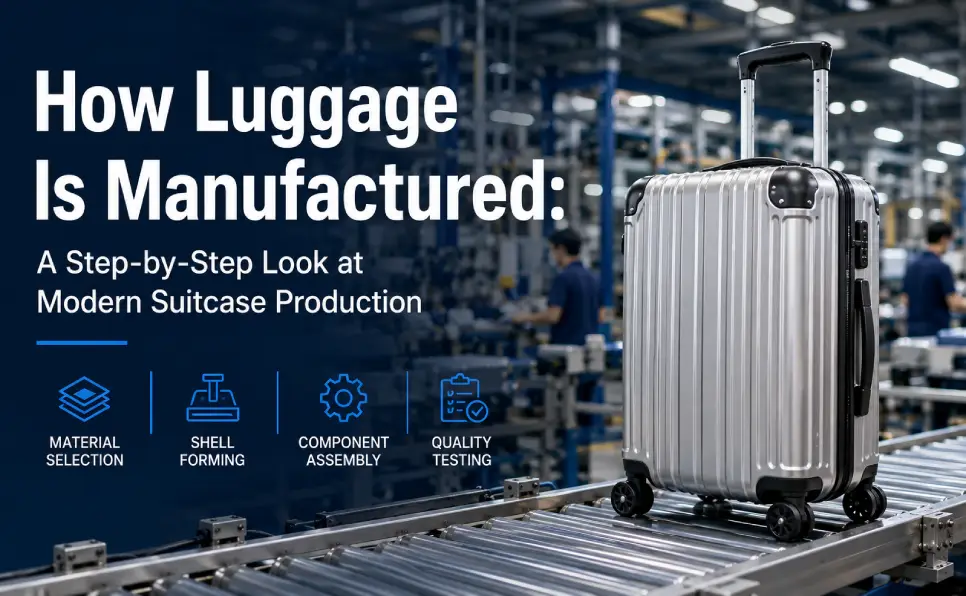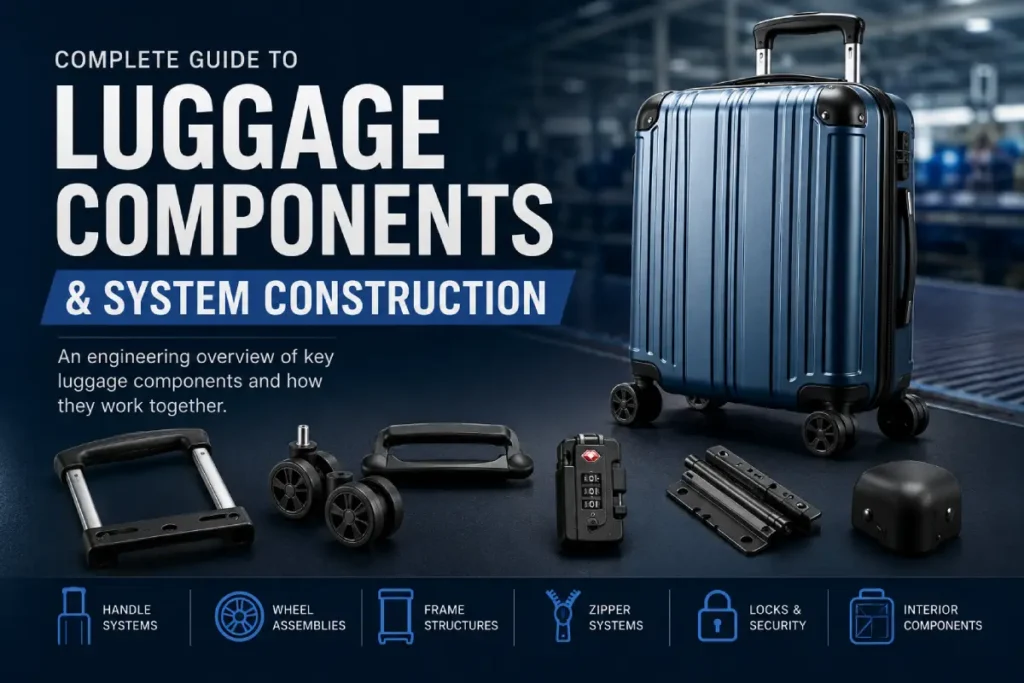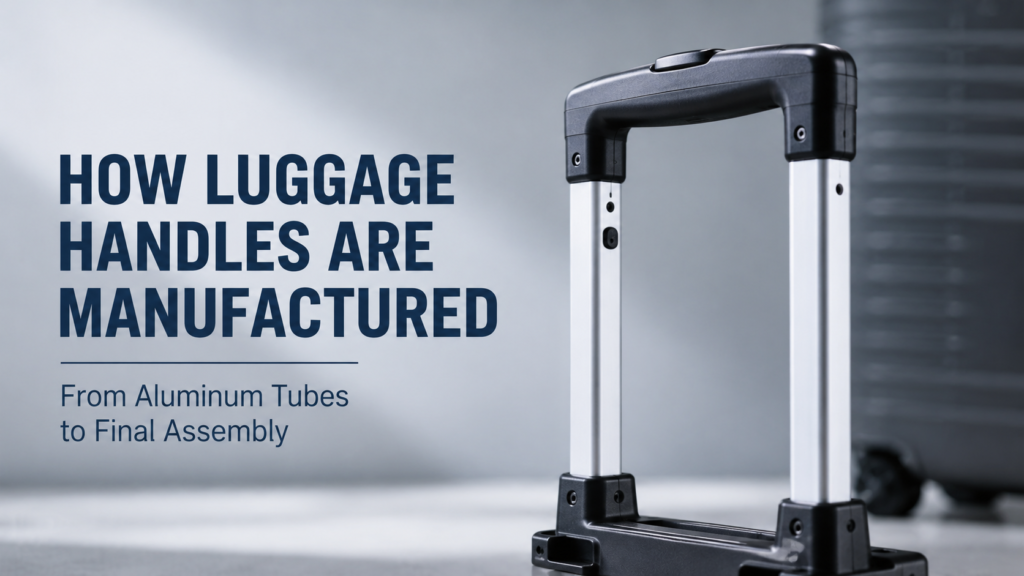
How luggage handles are manufactured directly affects a suitcase’s durability, stability, and user experience. Although a telescopic handle may appear to be a simple component, it combines precision metal processing, plastic injection molding, surface finishing, and assembly into one integrated system. Small variations introduced during production can affect extension smoothness, locking performance, and long-term reliability.
For luggage brands and OEM buyers, understanding how luggage handles are manufactured helps evaluate suppliers beyond product appearance. Material quality, manufacturing accuracy, and quality control all influence how a handle performs after thousands of extension and retraction cycles.
Why Manufacturing Quality Matters
A telescopic luggage handle is one of the most frequently used components on a suitcase. Every trip involves lifting, pulling, loading, and unloading, placing repeated stress on the handle system.
Unlike decorative components, a luggage handle contains several moving parts that must work together with tight dimensional tolerances. The aluminum tubes must slide smoothly without excessive clearance, the locking mechanism must engage consistently, and the plastic housing must support the entire structure without deformation.
For this reason, how luggage handles are manufactured plays an important role in reducing warranty claims and improving product consistency.
Selecting the Right Materials
The manufacturing process begins with raw material selection.
Most high-quality telescopic handles use 6063 aluminum alloy for the telescopic tubes because it provides an effective balance between strength, weight, corrosion resistance, and extrusion performance. Compared with ordinary steel tubes, aluminum reduces overall luggage weight while maintaining sufficient structural rigidity.
Plastic components are typically produced from PP, ABS, or reinforced engineering plastics, depending on the product design. These materials are used for handle grips, guide sleeves, locking housings, and internal structural parts.
Material selection is always matched to the intended luggage type, whether the system is designed for ABS, PC, PP, aluminum-frame, or soft-shell suitcases.
Aluminum Tube Extrusion
One of the most important stages in how luggage handles are manufactured is aluminum extrusion.
Aluminum billets are heated and pushed through custom extrusion dies to produce hollow tubes with precise cross-sectional dimensions. The profile must remain consistent throughout the entire length because the telescopic tubes will later slide inside one another.
After extrusion, the tubes undergo straightening, cooling, and cutting before moving to the machining department.
Dimensional consistency at this stage directly affects handle stability. Even small deviations may result in excessive wobbling or increased sliding resistance during use. Manufacturers therefore monitor tube dimensions continuously throughout production.
Precision Machining
Extruded tubes cannot be assembled immediately.
Each tube passes through a series of machining operations that create mounting holes, positioning slots, locking openings, and other structural features required for the telescopic system.
Modern luggage handle factories commonly use CNC machining and automated punching equipment to maintain dimensional consistency across large production batches.
The machining process also determines how accurately the locking mechanism aligns during extension and retraction. Poor machining accuracy often leads to uneven movement or incomplete locking after assembly.
This stage is one of the reasons why luggage handles are manufactured, which involves much more than simply producing aluminum tubes.
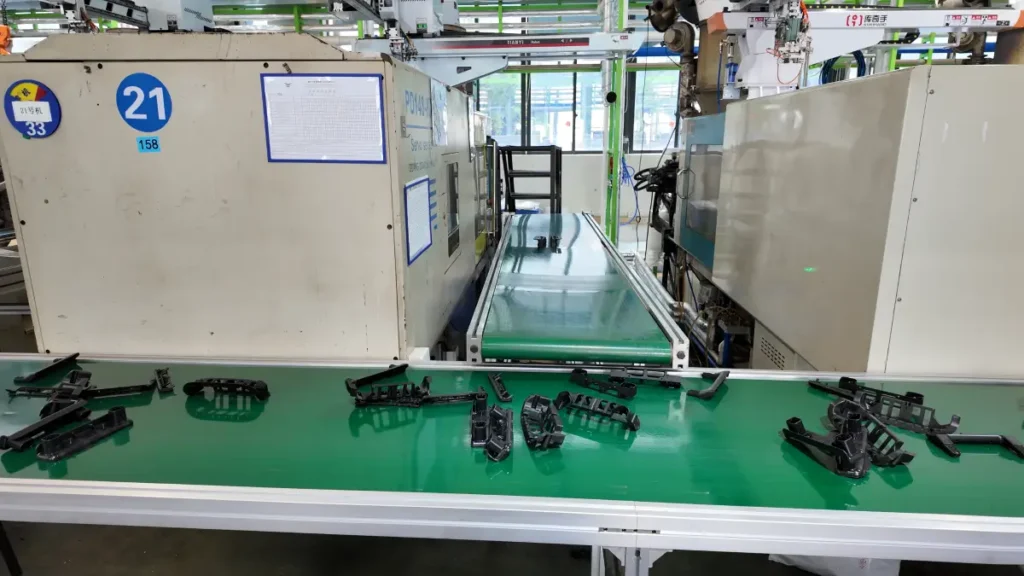
Plastic Injection Molding
While aluminum tubes provide structural strength, plastic components determine much of the handle’s operating experience.
Injection molding produces parts such as:
- Handle grips
- Guide sleeves
- Button housings
- Locking components
- Decorative covers
The mold design must control shrinkage and maintain tight tolerances so that every plastic component fits accurately with the aluminum tubes.
Surface quality is equally important. Burrs, flash, or dimensional variation can increase friction and reduce the smoothness of handle operation.
Surface Finishing
Before assembly, aluminum tubes receive surface treatment to improve both appearance and durability.
Common finishing processes include:
- Anodizing
- Electrophoretic coating
- Powder coating
These finishes improve corrosion resistance while creating a smoother surface for telescopic movement.
The finish also contributes to the product’s visual quality. Premium luggage brands often specify different colors or textures to match their suitcase collections.
Assembly of the Telescopic Handle System
After all components are completed, technicians assemble the telescopic handle system.
The process typically includes:
- Installing guide sleeves
- Mounting locking pins and springs
- Assembling telescopic tubes
- Installing the push-button mechanism
- Securing the top handle
- Functional testing
Assembly requires careful alignment because several components operate simultaneously whenever the user presses the release button.
Even with high-quality raw materials, poor assembly can introduce excessive clearance, unstable locking, or inconsistent extension.
Readers interested in the complete suitcase production process can also explore our guide on how luggage is manufactured, which explains how handle systems integrate into final suitcase assembly.
Quality Inspection and Durability Testing
Quality inspection is the final stage of how luggage handles are manufactured.
Rather than checking only appearance, manufacturers evaluate the mechanical performance of each handle system.
Typical inspections include:
- Extension and retraction smoothness
- Locking consistency
- Dimensional inspection
- Static load testing
- Fatigue cycle testing
- Surface finish inspection
Many OEM factories also perform repeated extension tests to simulate years of daily use before approving products for shipment.
Because the telescopic handle is one of the highest-load components on a suitcase, testing standards are generally stricter than for cosmetic parts.
OEM Manufacturing for Different Suitcase Designs
Although the manufacturing principles remain similar, handle systems are rarely identical across different luggage brands.
OEM projects often require customization:
- Installation dimensions
- Tube lengths
- Extension stages
- Handle grip designs
- Surface finishes
- Mounting structures
Manufacturers work closely with luggage factories during product development to ensure compatibility with different shell structures and suitcase sizes.
Understanding how luggage handles are manufactured also helps sourcing teams evaluate whether a supplier can support customized production rather than only standard products.
For a broader overview of suitcase systems, readers can also refer to our Complete Guide to Luggage Components, which explains how telescopic handles interact with wheels, shells, locks, and other structural parts.
Conclusion
Understanding how luggage handles are manufactured reveals why product quality depends on far more than the finished appearance. Material selection, aluminum extrusion, precision machining, plastic injection molding, assembly, and durability testing all contribute to the final performance of a telescopic handle system.
For luggage brands, importers, and OEM buyers, evaluating a handle supplier means looking beyond specifications on paper. Consistent manufacturing processes, reliable quality control, and engineering capability are what ensure a telescopic handle performs smoothly throughout years of travel.