
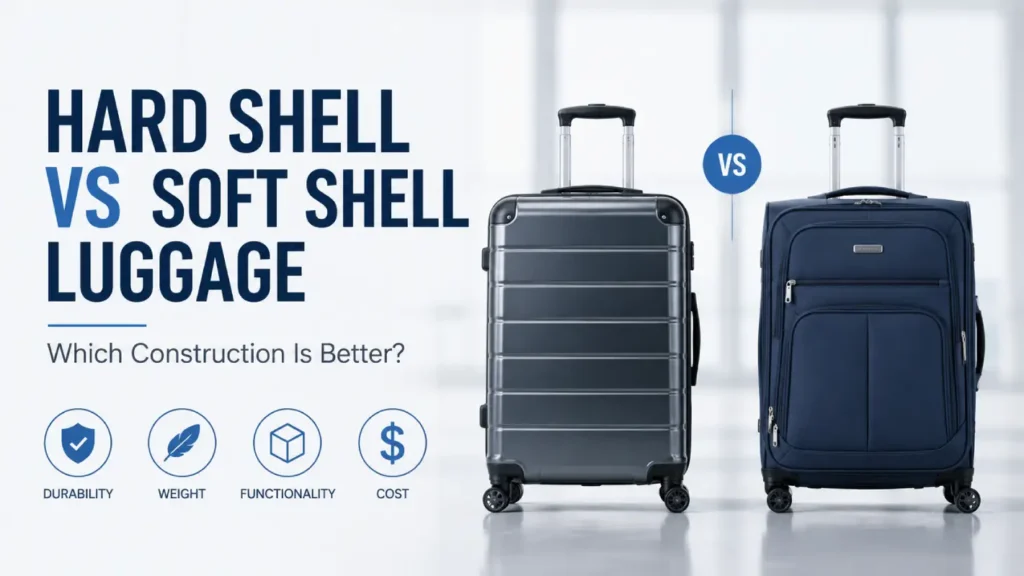
Hard shell vs. soft shell luggage is one of the most common comparisons made by luggage brands, importers, and travelers when selecting or developing a new suitcase. While both constructions serve the same purpose, they differ significantly in material selection, structural design, manufacturing methods, and long-term performance. Understanding these differences helps manufacturers choose suitable production processes and enables buyers to select products that match their target market.
Understanding Hard Shell vs Soft Shell Luggage Construction
When discussing hard shell vs. soft shell luggage, the primary difference lies in how the suitcase body is constructed.
Hard-shell luggage uses rigid thermoplastic or metal panels to create a self-supporting structure. Common materials include polycarbonate (PC), ABS, polypropylene (PP), and aluminum.
Soft-shell luggage relies on textile fabrics supported by an internal frame. Polyester, nylon, and recycled woven materials are widely used depending on the product’s positioning and price range.
Although both designs share many of the same luggage components, including telescopic handles, wheel systems, locks, and internal compartments, their structural behavior differs considerably under impact and load.
Materials Used in Hard Shell Luggage
Hard-shell suitcases are manufactured using materials selected for rigidity, dimensional stability, and impact resistance.
Common materials include:
- Polycarbonate (PC)
- ABS
- Polypropylene (PP)
- Aluminum
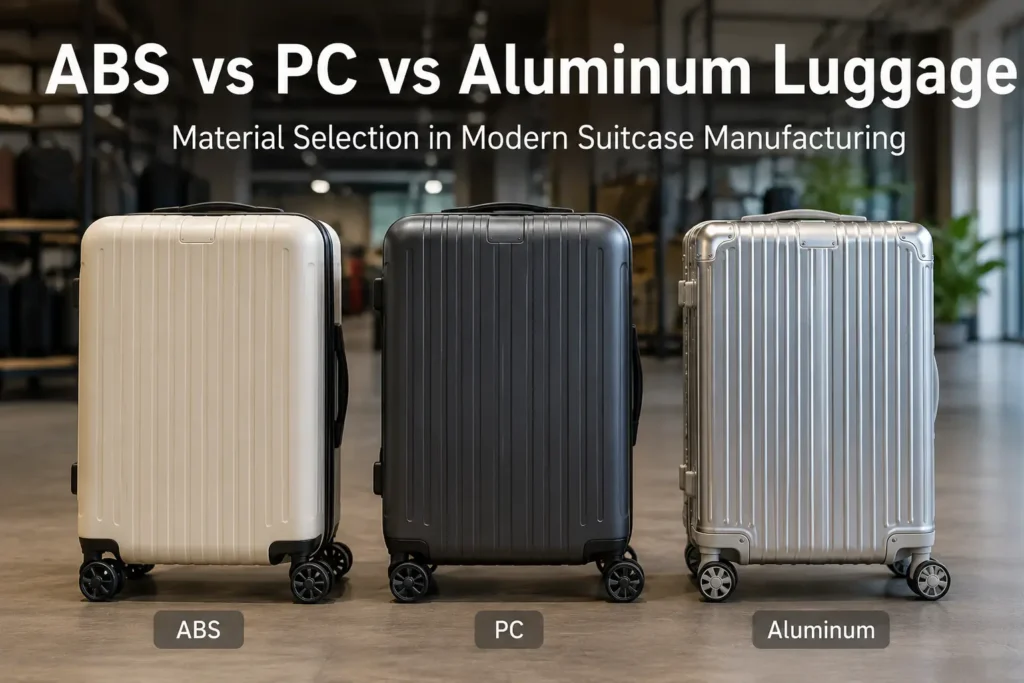
Each material offers different mechanical properties. Polycarbonate provides excellent impact resistance and flexibility, while ABS remains popular in entry-level products because of its lower manufacturing cost. Polypropylene offers good fatigue resistance and lightweight performance, whereas aluminum is commonly used for premium luggage requiring higher structural strength.
Readers interested in material selection can also explore our detailed comparison of ABS vs. PC vs. Aluminum Luggage, which explains how different shell materials affect durability and manufacturing.
Soft Shell Luggage Materials and Construction
Soft-shell luggage is built around high-strength fabrics rather than rigid outer shells.
Typical materials include:
- Polyester
- Ballistic nylon
- Oxford fabric
- Recycled textile materials
These fabrics are sewn together and reinforced with internal frame structures, foam layers, and support panels. The manufacturing process differs from hard-shell production because fabric cutting, stitching, reinforcement, and zipper installation become major assembly operations.
Although the outer construction is flexible, internal reinforcement helps maintain the suitcase’s shape during transportation.
Durability Comparison
Comparing hard-shell vs. soft-shell luggage requires looking beyond shell materials alone.
Hard-shell luggage generally performs better against compression, stacking loads, and moderate impacts. The rigid shell distributes external forces across a larger surface area, helping protect delicate contents.
Soft-shell luggage performs differently. While fabric surfaces can absorb certain impacts without cracking, they are generally more susceptible to abrasion, punctures, and moisture if lower-grade materials are used.
Overall durability also depends on manufacturing quality, shell thickness, reinforcement design, and component selection rather than shell type alone.
Weight and Travel Performance
Weight plays an important role when evaluating hard shell vs. soft shell luggage.
Advances in polycarbonate and polypropylene technology have significantly reduced the weight of modern hard-shell luggage. Premium PC luggage can now approach the weight of many fabric cases while offering improved structural rigidity.
Soft-shell luggage still maintains advantages in flexibility and external storage. Expandable compartments and additional exterior pockets make it suitable for business travelers or users who require easier access to frequently used items.
For airlines with strict baggage weight limits, total suitcase construction—including shell material, handle system, and wheel assembly—often has a greater influence than shell type alone.
Manufacturing Differences
From a factory perspective, hard-shell vs. soft-shell luggage involves two distinct production systems.
Hard-shell luggage production typically includes:
- Sheet extrusion or material preparation
- Vacuum forming or injection molding
- Shell trimming
- Hole machining
- Component installation
- Final assembly
To understand this process in greater detail, see our guide explaining how luggage is manufactured, which covers each production stage from raw materials to finished products.
Soft-shell luggage manufacturing emphasizes:
- Fabric cutting
- Sewing operations
- Foam lamination
- Frame installation
- Zipper assembly
- Final stitching and inspection
Because the manufacturing methods differ considerably, factories often specialize in either hard-shell or soft-shell production.
Component Compatibility
Regardless of shell construction, most suitcases rely on the same functional systems.
These include:
- telescopic handles
- wheel assemblies
- locks
- corner reinforcements
- carry handles
- internal support frames
The performance of these luggage components directly influences user experience throughout the product’s service life.
For OEM projects, manufacturers typically customize mounting dimensions to ensure compatibility with different suitcase structures and shell thicknesses.
Which Construction Is Better?
There is no universal answer when comparing hard shell vs. soft shell luggage because product requirements vary between brands and market segments.
Hard-shell luggage is generally preferred when:
- Better impact protection is required
- A premium appearance is important
- Waterproof performance is a priority
- Structural rigidity is valued
Soft-shell luggage is often selected when:
- Flexibility is important
- Expandable storage is preferred
- Lower production costs are required
- Lightweight textile construction fits the target market
For product development teams, the decision should be based on customer needs, manufacturing capability, and long-term product positioning rather than trends alone.
Conclusion
The discussion around hard shell vs. soft shell luggage extends beyond appearance. Material properties, manufacturing processes, structural design, component compatibility, and expected usage all contribute to overall product performance.
For luggage brands and sourcing teams, selecting the appropriate construction begins with understanding the intended market, product specifications, and manufacturing requirements. Combining suitable shell materials with reliable luggage components and consistent production standards leads to products that perform well throughout their service life.
Pingback: ABS vs PC vs Aluminum Luggage | Material Comparison