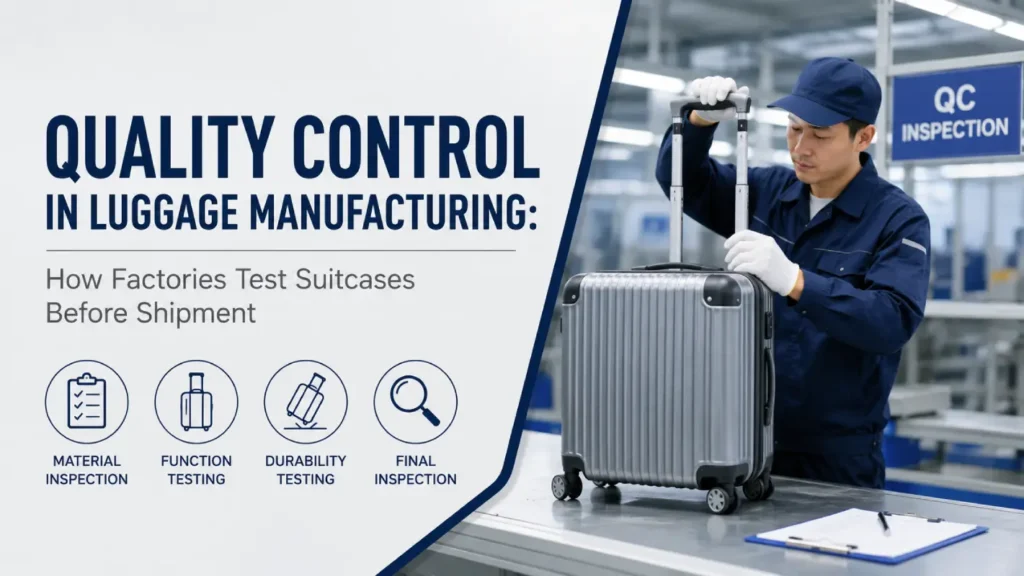
Quality control in luggage manufacturing plays a direct role in product durability, customer satisfaction, and long-term brand reputation. A suitcase may appear identical on a showroom floor, yet differences in inspection procedures and testing standards often determine how the product performs after months or years of use.
For luggage brands, importers, and sourcing teams, understanding quality control in luggage manufacturing helps evaluate supplier capabilities beyond price and production capacity. In many sourcing projects, the effectiveness of quality control in luggage manufacturing has a direct impact on warranty costs, product consistency, and long-term supplier performance.
Why Quality Control in Luggage Manufacturing Matters
Quality control begins long before a finished suitcase reaches the packing area.
Modern luggage products combine multiple systems, including shell structures, wheel assemblies, telescopic handles, locks, zippers, and internal reinforcement components. These luggage components must work together as an integrated system, so inspection cannot focus on a single part alone. Variations in any of these areas can affect overall performance.
Effective quality control in luggage manufacturing aims to identify potential defects before products enter distribution channels, reducing warranty claims and improving production consistency. Factories with mature quality control in luggage manufacturing typically establish measurable inspection criteria for each production stage rather than relying on visual inspection alone.
Factories typically establish inspection procedures at several stages rather than relying solely on final product checks.
Incoming Material Inspection
The first stage of quality control in luggage manufacturing focuses on raw materials and purchased components.
Factories commonly inspect:
- polycarbonate sheets
- ABS materials
- aluminum tubes
- wheel assemblies
- locks
- zipper systems
Material verification helps ensure that incoming components meet project specifications before production begins.
For OEM projects, suppliers often maintain separate inspection standards according to customer requirements and product positioning.
Without proper incoming inspection procedures, quality control in luggage manufacturing becomes significantly more difficult because material defects may not become visible until final assembly or product testing.
In-Process Quality Checks During Production
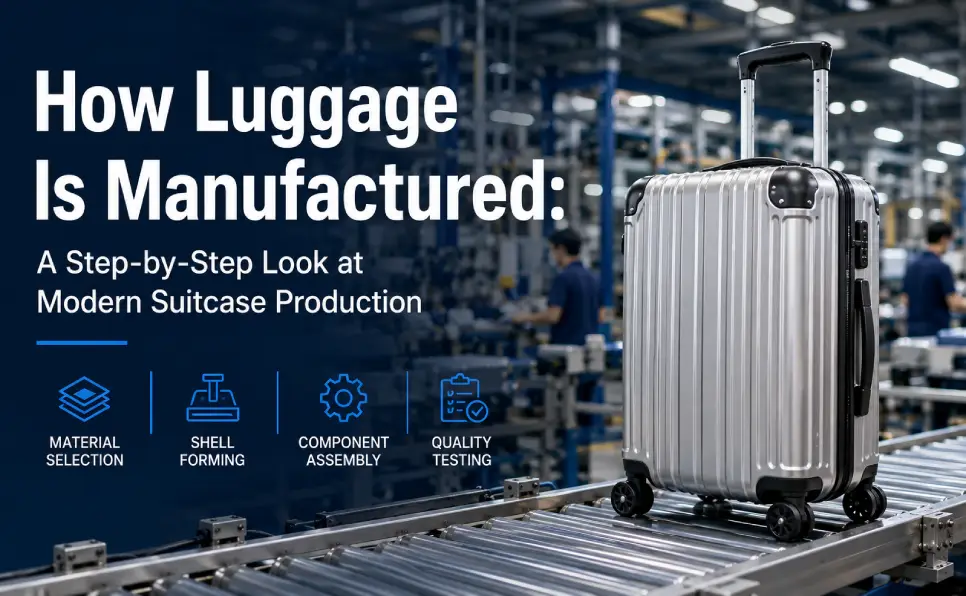
Inspection continues throughout the manufacturing process. These inspection procedures form an important part of how luggage is manufactured, ensuring that each production stage meets the required dimensional and functional standards before moving to the next operation.
Production personnel and quality inspectors monitor:
- shell dimensions
- forming consistency
- assembly tolerances
- drilling accuracy
- component fitment
Many luggage factories implement in-process audits because correcting defects during production is generally more efficient than identifying them after final assembly.
For this reason, many factories invest heavily in process monitoring systems as part of their overall quality control strategy in luggage manufacturing.
Testing Telescopic Handle Systems
Handle systems receive significant attention during luggage inspection because they experience repeated loading cycles during normal travel.
Factories evaluate:
- extension smoothness
- locking accuracy
- structural stability
- handle wobble
- cycle durability
A telescopic handle that functions correctly during initial assembly may still develop issues after repeated use if dimensional tolerances are not properly controlled.
For this reason, many brands work closely with an experienced luggage handle manufacturer to ensure component consistency before final suitcase assembly begins.
Readers interested in handle system construction can also refer to our guide explaining how telescopic luggage handles work.
Wheel Performance Testing
Wheel assemblies often experience continuous movement under load throughout the life of a suitcase.
Factories typically conduct rolling tests to evaluate:
- wheel wear
- bearing performance
- housing durability
- rolling stability
Test equipment may simulate extended travel conditions by repeatedly moving loaded luggage over controlled surfaces.
Results help identify weaknesses before products enter mass distribution.
Drop Testing and Impact Evaluation
Physical impact remains one of the most common causes of luggage damage during transportation.
Many manufacturers conduct drop tests to evaluate structural integrity under sudden loading conditions.
Testing commonly examines:
- shell deformation
- wheel attachment strength
- handle mounting stability
- corner protection performance
Quality control in luggage manufacturing often includes multiple drop scenarios because impact forces vary depending on suitcase size and weight.
Final Inspection Before Shipment
Final inspection serves as the last verification stage before packaging.
Inspectors review:
- cosmetic appearance
- assembly quality
- logo placement
- component functionality
- packaging condition
Products that fail inspection are separated for corrective action before shipment approval.
Factories supplying international brands often maintain documented inspection records to support traceability and customer audits. Although final inspection is important, experienced manufacturers understand that quality control in luggage manufacturing must be integrated throughout the production process rather than concentrated at the shipment stage.
Quality Standards and Supplier Evaluation
Many sourcing teams use quality performance as a key factor when selecting manufacturing partners because strong quality control in luggage manufacturing often indicates a supplier’s ability to maintain consistency across large production volumes.
A supplier’s inspection procedures often provide more insight into long-term reliability than production capacity alone.
When evaluating factories, buyers frequently review:
- inspection systems
- testing equipment
- defect reporting processes
- corrective action procedures
- production consistency records
These factors help determine whether quality control in luggage manufacturing is integrated into daily operations or treated only as a final checkpoint.
Conclusion
Quality control in luggage manufacturing extends far beyond final inspection. Material verification, production monitoring, handle testing, wheel evaluation, impact testing, and shipment inspections all contribute to product consistency and long-term durability.
For luggage brands and sourcing teams, understanding how factories approach quality control provides valuable insight into supplier capability and product reliability. Strong inspection systems generally reduce risk throughout the supply chain and support more predictable product performance in the market.
Read more about: ABS vs PC vs Aluminum Luggage: Material Selection in Modern Suitcase Manufacturing