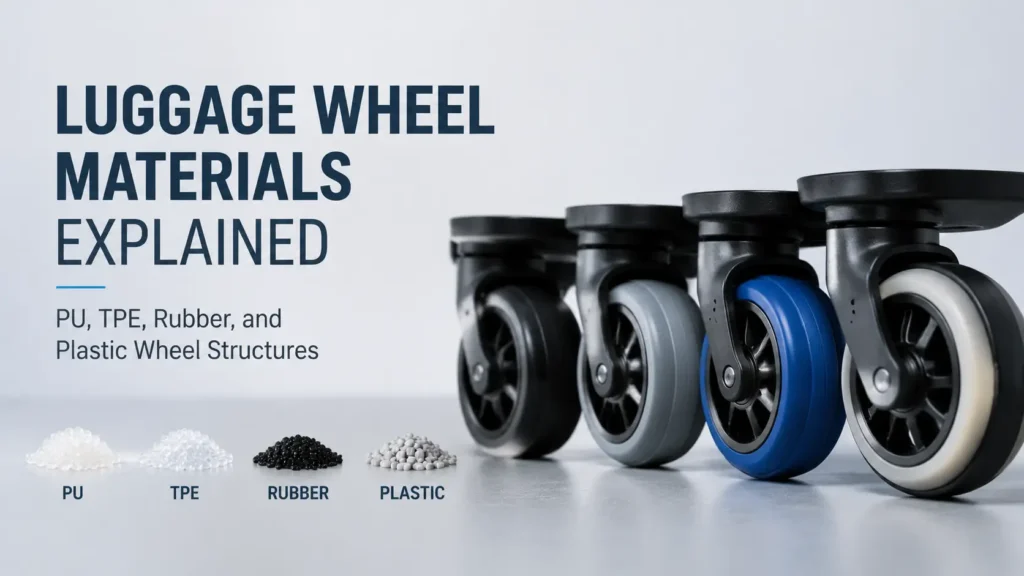
Luggage wheel materials directly affect rolling performance, durability, noise level, and the overall travel experience of a suitcase. Although luggage wheels may look similar from the outside, different materials create noticeable differences in wear resistance, shock absorption, and long-term reliability.
For luggage brands and OEM buyers, selecting suitable luggage wheel materials requires considering not only the wheel surface but also the suitcase structure, target market, expected load, and production requirements.
A premium suitcase designed for frequent travelers usually requires a different wheel material combination compared with lightweight luggage produced for occasional use.
Why Luggage Wheel Materials Matter
A suitcase wheel works under continuous mechanical stress.
During transportation, wheels experience:
- Repeated rolling friction
- Impact from uneven surfaces
- Different loading weights
- Temperature changes during storage and transportation
The wheel material determines how effectively it handles these conditions.
A harder material may provide better wear resistance but can create more noise on hard floors. A softer material can improve rolling comfort but may wear faster under heavy loads.
For this reason, manufacturers select luggage wheel materials based on the intended application rather than choosing a single material for every product. For this reason, manufacturers select luggage wheel materials based on the intended application rather than choosing a single material for every product.
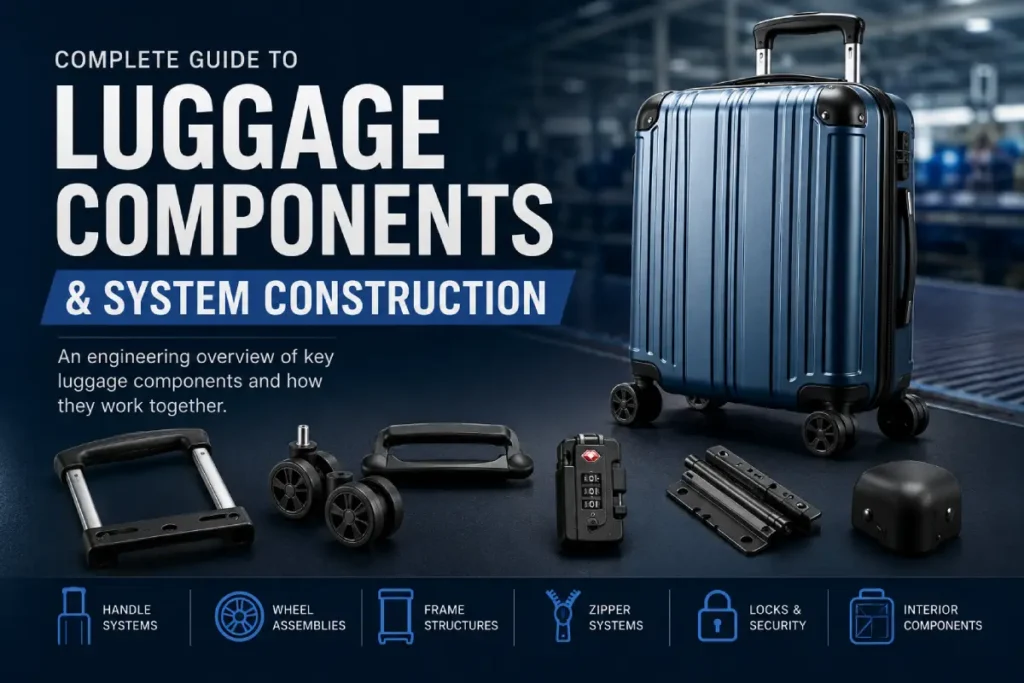
Wheel materials are only one part of the complete suitcase structure. The wheel system needs to work together with handles, frames, shells, and other components to achieve reliable performance. Our guide Complete Guide to Luggage Components explains how these individual parts work together in modern suitcase construction.
PU Luggage Wheels: Balance Between Durability and Comfort
Polyurethane (PU) is one of the most commonly used materials for modern suitcase wheels.
PU combines flexibility with abrasion resistance, making it suitable for luggage products that require smoother movement and lower rolling noise.
Main advantages include:
- Good wear resistance
- Lower rolling noise
- Better shock absorption
- Smooth movement on hard surfaces
Many premium luggage brands use PU wheel surfaces because they provide a more comfortable pulling experience in airports, hotels, and urban environments.
However, PU formulation plays an important role. Different hardness levels create different performance characteristics. A softer PU compound improves comfort, while a harder compound improves resistance against wear.
TPE Luggage Wheels: Flexible and Cost-Effective Performance
Thermoplastic Elastomer (TPE) is another common choice among luggage manufacturers.
TPE combines characteristics of rubber and plastic, allowing manufacturers to adjust hardness, flexibility, and production efficiency.
Typical benefits of TPE include:
- Flexible structure
- Good impact resistance
- Stable production performance
- Lower manufacturing cost
TPE wheels are widely used in different luggage categories because they provide a practical balance between performance and price.
For large-scale OEM projects, manufacturers often choose TPE when they need consistent quality across high production volumes.
Rubber Wheels: Traditional Durability Option
Rubber was one of the earlier materials used for luggage wheels.
Compared with many plastic-based materials, rubber provides excellent elasticity and vibration absorption.
Advantages include:
- Strong shock absorption
- Quiet rolling performance
- Good grip on different surfaces
However, natural rubber and some rubber compounds may have limitations in long-term storage, temperature resistance, and production consistency.
Modern luggage manufacturers often replace traditional rubber wheels with engineered materials such as PU and TPE to achieve more predictable performance.
Plastic Wheel Structures and Internal Components
Although the outer wheel surface receives most attention, the internal structure also affects performance.
Many luggage wheels include:
- Plastic wheel cores
- Bearing housings
- Reinforced mounting brackets
- Axle systems
Engineering plastics such as PP, PA, and reinforced nylon are commonly used for these structural parts.
These materials provide:
- Lightweight construction
- Dimensional stability
- Impact resistance
- Easy injection molding
The combination of outer wheel material and internal structure determines the final performance of the complete wheel system.
Single Material vs Multi-Material Wheel Design
Modern luggage wheels often use multiple materials instead of a single compound.
A typical design may include:
- PU or TPE outer layer for rolling performance
- Plastic core for structural support
- Metal bearings for smooth rotation
This multi-material approach allows manufacturers to optimize different functions within one wheel system.
For example, the outer layer focuses on floor contact and noise reduction, while the internal structure supports load capacity and durability.
This design method is commonly used in OEM luggage production because it allows brands to customize wheel performance according to product positioning.
Choosing the Right Luggage Wheel Materials for Different Products
Different luggage categories require different wheel specifications.
Lightweight Cabin Luggage
Usually focuses on:
- Low weight
- Smooth movement
- Compact wheel design
Large Checked Luggage
Requires:
- Higher load capacity
- Stronger wheel housing
- Better impact resistance
Premium Travel Luggage
Often prioritizes:
- Lower noise
- Better rolling comfort
- Longer service life
Therefore, luggage brands should evaluate wheel materials together with suitcase size, structure, and target customers.
Manufacturing Considerations for OEM Buyers
When selecting an OEM wheel supplier, material selection is only one part of the evaluation process.
Manufacturers should also consider:
- Mold precision
- Material consistency
- Bearing quality
- Assembly accuracy
- Durability testing
A reliable luggage components supplier should be able to recommend suitable wheel structures according to different suitcase designs.
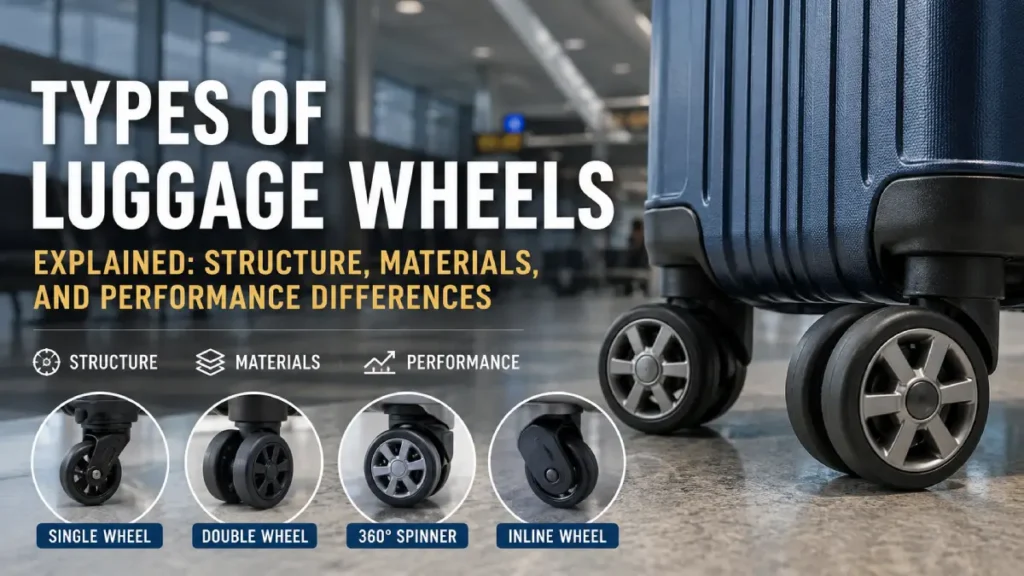
For a broader understanding of wheel structures, you can also read our guide on Types of Luggage Wheels Explained, which compares different wheel designs and their performance differences.
A reliable luggage components supplier should be able to recommend suitable wheel structures according to different suitcase designs.
The wheel production process is also connected with the wider suitcase manufacturing workflow. From material selection and component production to final assembly, how luggage is manufactured determines how different parts work together as a complete travel product.
Conclusion
Understanding luggage wheel materials helps luggage brands make better decisions during product development. PU, TPE, rubber, and engineering plastics each provide different advantages depending on durability, comfort, cost, and manufacturing requirements.
A high-quality luggage wheel is not determined by one material alone. The final performance depends on material selection, structural design, bearing integration, and production accuracy.
For OEM luggage projects, choosing the right wheel material combination helps create products that perform consistently across different travel environments.