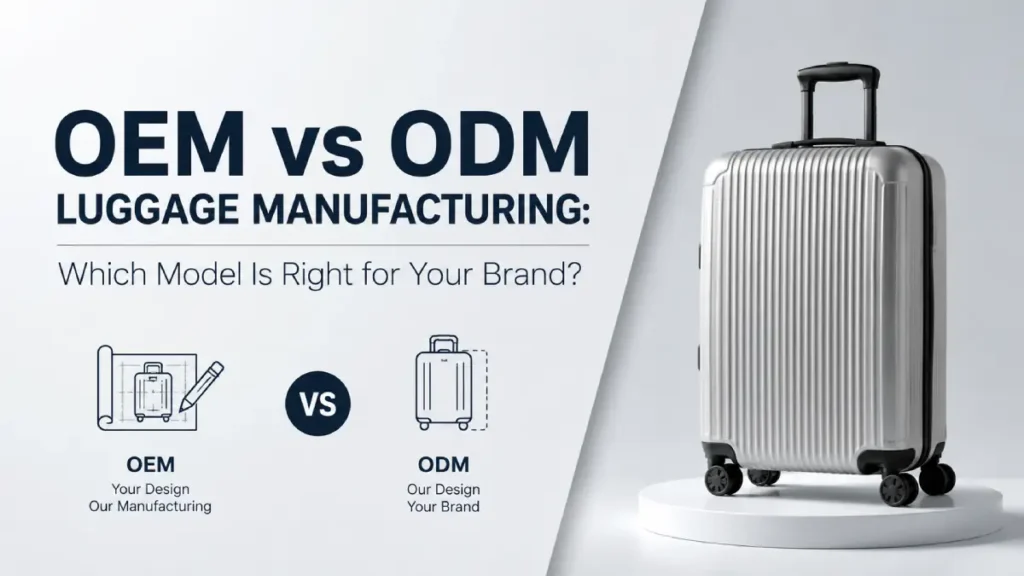
OEM vs. ODM luggage manufacturing is one of the first decisions luggage brands face when developing a new product line. The choice affects development costs, launch timelines, tooling investment, intellectual property ownership, and supplier involvement throughout the project.
Many buyers use the terms interchangeably, yet OEM and ODM represent two very different manufacturing approaches. Understanding the differences helps sourcing teams evaluate suppliers, allocate development budgets, and reduce project risks before production begins.
Understanding OEM vs ODM Luggage Manufacturing
OEM vs ODM luggage manufacturing refers to two distinct cooperation models between brands and factories.
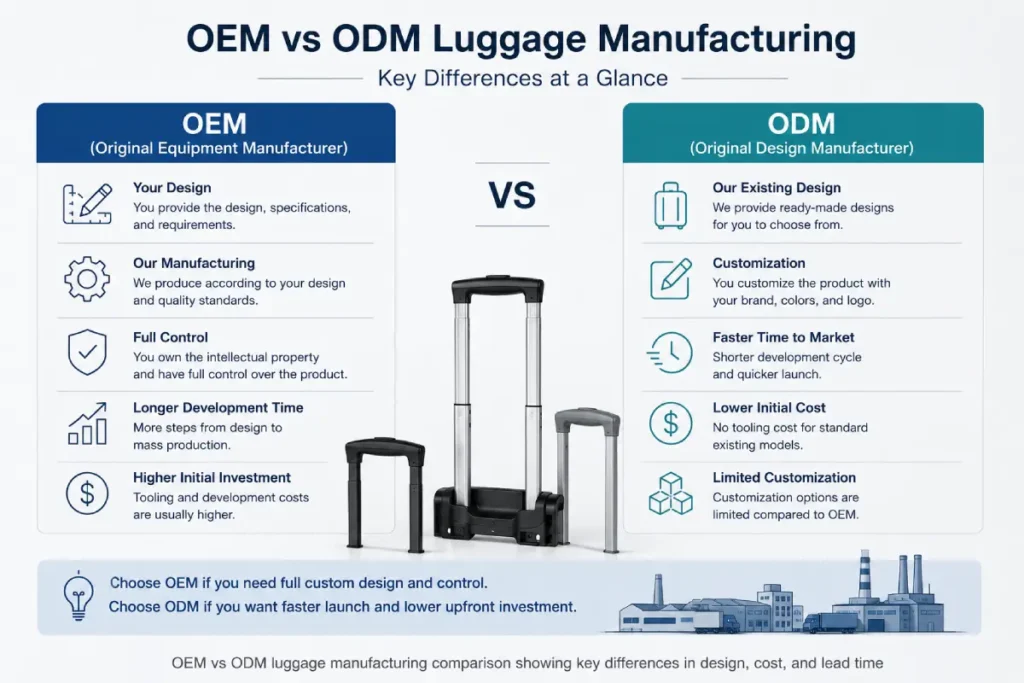
In an OEM project, the buyer owns the product concept and specifications. The manufacturer produces according to drawings, samples, technical requirements, and quality standards provided by the customer.
In an ODM project, the manufacturer develops the product and provides an existing design platform that buyers can customize through branding, colors, materials, or selected features.
Both models are common throughout the luggage industry, but they serve different business objectives.
OEM Luggage Manufacturing: Greater Control Over Product Development
OEM manufacturing is often selected by brands that want full control over product design.
Under this model, buyers typically provide:
- product drawings
- technical specifications
- performance requirements
- material selections
- branding elements
The factory focuses on engineering validation, tooling production, sample development, testing, and mass manufacturing.
OEM projects generally require longer development cycles because every component must meet the customer’s specifications.
For brands seeking product differentiation, OEM luggage manufacturing offers greater flexibility throughout the design process.
ODM Luggage Manufacturing: Faster Market Entry
ODM luggage manufacturing allows brands to launch products using designs already developed by the factory.
Rather than starting from a blank sheet of paper, buyers select from existing product platforms and make limited modifications.
Common ODM customizations include:
- logo application
- color changes
- packaging design
- material upgrades
- hardware selection
Because product development work is largely completed in advance, ODM projects usually move to production faster than OEM programs.
For new brands entering the market, ODM can reduce development costs while shortening launch schedules.
Cost Differences Between OEM and ODM Projects
When evaluating OEM vs. ODM luggage manufacturing, cost structure often becomes a major consideration.
OEM projects typically involve:
- tooling investment
- product development costs
- engineering validation
- prototype revisions
These expenses increase upfront investment but allow brands to create proprietary products.
ODM projects usually require lower initial investment because the manufacturer has already absorbed tooling and product development costs.
The long-term economics depend on product strategy, sales volume, and brand positioning.
Product Differentiation and Market Positioning
Product uniqueness often determines whether OEM or ODM is the better option.
Brands competing primarily on price frequently adopt ODM models because development costs remain lower and launch schedules are shorter.
Companies targeting premium market segments often favor OEM projects because proprietary designs help create stronger product differentiation.
Within the luggage industry, this may involve customized shell structures, specialized wheel systems, unique locking mechanisms, or proprietary handle assemblies.
Therefore, OEM vs ODM luggage manufacturing becomes a strategic business decision rather than simply a production choice.
Supplier Requirements Under Each Model
Supplier capabilities become increasingly important as product complexity increases.
An OEM luggage manufacturer generally requires:
- engineering support
- tooling development capability
- sample validation processes
- project management systems
An ODM luggage manufacturer focuses more heavily on production efficiency, catalog management, and customization support.
Buyers should evaluate suppliers according to project requirements rather than assuming one model fits every product category.
Component Development Within OEM Projects
Many OEM luggage projects involve the development of custom luggage components alongside shell design. [Complete Guide to Luggage Components]
Telescopic handle systems, wheel assemblies, reinforcement structures, locks, and corner protectors frequently require engineering modifications during development.
For this reason, brands often work with specialized suppliers capable of supporting component customization throughout the luggage manufacturing process.
Component compatibility becomes especially important when multiple luggage sizes share a common product platform.
How OEM vs ODM Luggage Manufacturing Affects Lead Time
Lead time differences often influence sourcing decisions.
OEM projects require additional time for:
- design confirmation
- tooling production
- engineering testing
- sample approval
ODM projects generally bypass several of these stages because the product architecture already exists.
When market timing is a priority, ODM manufacturing may offer advantages. When product differentiation carries greater value, brands often accept the longer development cycle associated with OEM production.
OEM vs. ODM luggage manufacturing serves different business objectives and product strategies.
OEM projects provide greater design flexibility, stronger product differentiation, and increased control over intellectual property. ODM projects offer lower development costs, shorter lead times, and faster market entry.
For luggage brands, importers, and sourcing teams, selecting the right manufacturing model depends on product goals, budget allocation, development resources, and long-term market positioning. Evaluating OEM vs. ODM luggage manufacturing early in the sourcing process helps reduce uncertainty and improve decision-making throughout product development.
For more information on the luggage industry, please read the following two articles: