
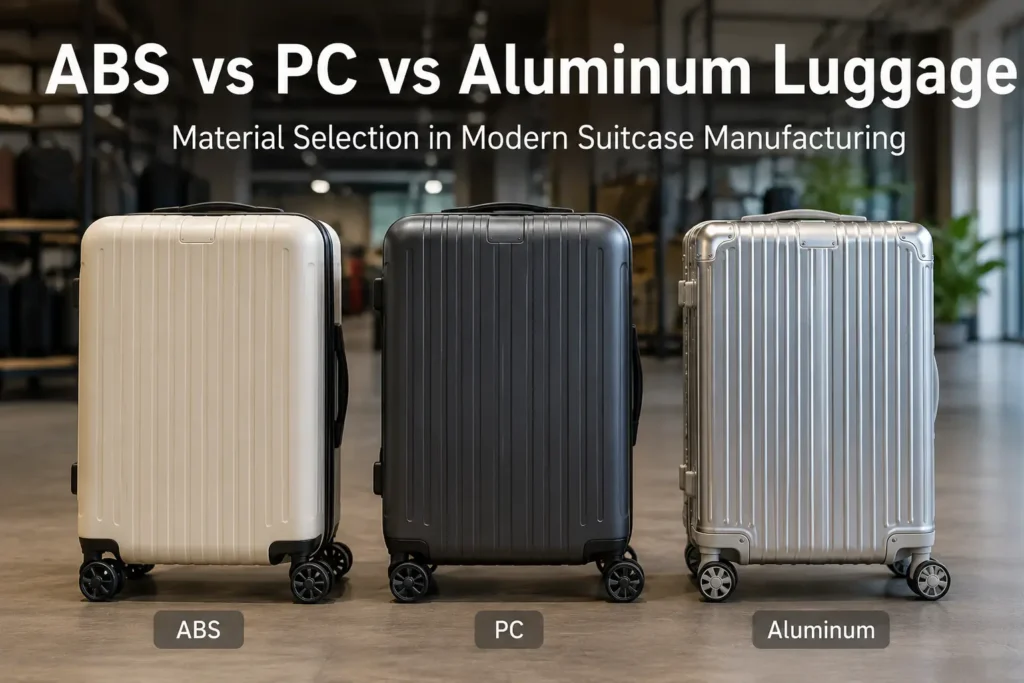
When comparing ABS vs PC vs aluminum luggage, material selection becomes one of the earliest decisions in luggage product development because shell construction influences weight, rigidity, manufacturing cost, surface appearance, and long-term durability.
In commercial luggage production, ABS, polycarbonate (PC), and aluminum are the three most widely used materials for hard-shell suitcase manufacturing. Each material follows a different production process, requires different tooling considerations, and performs differently under real transportation conditions.
For importers, luggage brands, and sourcing teams, understanding these differences helps avoid material specifications that look attractive on paper but create production or durability issues after products enter the market.
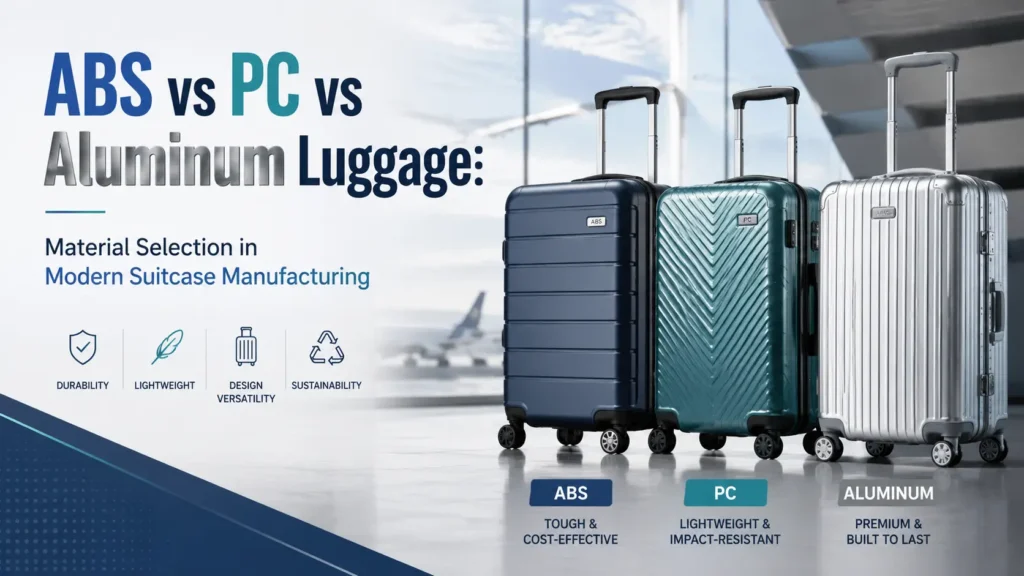
ABS vs PC vs Aluminum Luggage: Looking Beyond Shell Materials
ABS (Acrylonitrile Butadiene Styrene) remains common in entry-level and mid-range luggage manufacturing because the material is relatively economical and easy to thermoform.
Factories can process ABS sheets at lower temperatures compared with PC, which reduces production complexity and tooling wear. Surface finishing is also straightforward, making ABS suitable for a wide range of textures and decorative treatments.
The material does have limitations. ABS shells are generally less flexible than PC and are more likely to crack when exposed to repeated impact under heavy loading conditions.
For many OEM luggage projects targeting price-sensitive retail channels, ABS continues to be a practical option because production efficiency often outweighs the need for maximum impact resistance.
PC Luggage: Balancing Weight and Durability
PC has become one of the most widely used materials in premium hard-shell luggage manufacturing.
Unlike ABS, PC can flex under impact and then return to its original shape without permanent deformation. This characteristic helps reduce cracking during airport handling and transportation.
Factories producing PC luggage generally require tighter process control during thermoforming because temperature variation can affect surface quality and material performance.
PC also works well with modern spinner luggage systems because the shell structure can withstand repeated stress transferred from wheel assemblies and telescopic handle mounting areas.
Many manufacturers developing long-life luggage collections combine PC shells with reinforced luggage components to improve structural consistency throughout the product lifecycle.
Aluminium Luggage: Structural Rigidity and Premium Construction
Aluminum luggage follows a different manufacturing route from plastic-shell production.
Instead of thermoforming plastic sheets, factories fabricate aluminum panels and frame systems through cutting, bending, stamping, and assembly operations.
The resulting structure offers excellent rigidity and a distinctive appearance often associated with premium travel products.
Aluminum shells resist deformation under compression loading better than many plastic alternatives. The trade-off comes in weight, manufacturing cost, and visible surface wear. Scratches and dents often become part of the product’s appearance over time.
For manufacturers, aluminum luggage also requires more complex assembly procedures because frame systems, corner structures, and locking mechanisms become integral parts of the load-bearing structure.
Material Selection Beyond the Shell
Material performance cannot be evaluated independently from the rest of the suitcase system.
Wheel mounting points, telescopic luggage handle structures, reinforcement plates, and frame assemblies all interact with shell materials during actual use. A well-designed ABS suitcase can outperform a poorly engineered PC product if structural support and component integration are properly executed.
This is one reason why manufacturers often evaluate both shell materials and related luggage components together during product development and supplier selection.
Manufacturing Considerations
Material selection also influences production planning.
ABS generally supports lower manufacturing costs and shorter production cycles.
PC requires tighter process control and often higher raw material costs.
Aluminum demands specialised fabrication equipment and more labour-intensive assembly procedures.
These factors affect tooling investment, lead times, production capacity, and overall project economics.
For procurement teams evaluating ABS vs PC vs aluminum luggage, manufacturing complexity often becomes just as important as material performance.
Companies evaluating OEM suppliers should consider the complete production system rather than focusing exclusively on shell material specifications.
For a broader understanding of shell production and assembly operations, see our guide on how luggage is manufactured.
The discussion around ABS vs PC vs aluminum luggage does not produce a single material that fits every project or market segment.
ABS remains practical for cost-driven production programs. PC provides a strong balance between weight and impact resistance. Aluminium offers structural rigidity and premium positioning but requires a different manufacturing approach and higher investment.
For brands and sourcing teams, material selection should align with target market expectations, production requirements, component compatibility, and long-term durability objectives rather than relying solely on material marketing claims.
Continue Reading:
If you’d like to learn more about luggage design, the following article may also be useful:
Pingback: How Luggage Is Manufactured, 7-Step Suitcase Production
Pingback: Complete Guide to Luggage Components & Systems